When buyers start shopping for custom lightweight backpack manufacturers, most fall into the "grams vs. grains" trap. They chase a lower final weight so hard that they forget a bag still has to hold its shape under load. Over the years I've watched supplier after supplier hide behind thin 190T polyester, label it "technical fabric," and ship straps that let go the first time someone loads 5kg into the pack.
The 2026 market wants a light bag that still survives the daily commute and the weekend trail. The gap between a premium pack and a disposable one sits in the engineering, not the fabric spec sheet. That is the lens this guide is written through, and it is where a factory earns or loses your repeat orders. If you want the wider view first, our custom backpack manufacturer sourcing guide covers construction basics that apply across every model.
The "Lightweight Trap": Why Most Bulk Orders Fail in Durability
The most common mistake when vetting a supplier is ranking unit price above the physical parameters of the material. Plenty of factories win the quote with 420D nylon that skips high-tenacity fibers, then let the buyer discover the shortfall after the container lands.
The junction between a shoulder strap and the main body is a predictable high-stress area on a lightweight backpack. The approved construction should specify a repeatable bartack pattern, reinforcement material, seam allowance, and a load-test method appropriate to the intended payload. Elandmake checks these dimensions and reinforcement points against the approved sample so tension spreads along the seam instead of concentrating on one weak stitch line.
This is also why a low MOQ matters for a first run. We start bulk production at MOQ 300, which lets a brand pressure-test real construction on a small batch before committing to thousands of units.
Beyond the Fabric: Advanced Branding for a Lightweight Backpack with Logo
Applying a lightweight backpack with logo is a precision job, and it trips up many suppliers. On ultralight materials like 210T ripstop, heavy-ink screen printing stiffens the fabric and starts "cracking" around the branded panel after a few folds.
For clean branding on thin fabric, we lean on three factory methods:
- Silicone Heat Transfer: moves with the fabric and won't peel under compression, so it suits foldable packs.
- Ultrasonic Welding: attaches a logo patch without needle holes, keeping any waterproof coating intact.
- Reflective Sublimation: best for safety-focused brands, since it sets the mark into the fibers and adds zero weight.
Private-label work goes past the logo itself: custom zipper pulls, woven main labels, care tags, and retail-ready polybags with your barcode all get locked into the tech pack so the goods arrive shelf- or FBA-ready.
Technical Deep Dive: 210T Ripstop vs. 420D Nylon Cost and Performance
Choosing between 210T ripstop and 420D nylon is the decision that shapes the rest of the design. Here is the physics we walk clients through:
| Feature | 210T Ripstop Nylon | 420D High-Tenacity Nylon |
|---|---|---|
| Weight | 65-70 GSM | 150-180 GSM |
| Tensile Strength | High (due to cross-hatch) | Very High |
| Best Use Case | Ultralight Foldable Backpacks | Daily Commuter/Technical Packs |
| Water Resistance | PU 1000mm - 3000mm | PU 2000mm+ |
The choice usually comes down to hand feel. 210T is far lighter but carries a "crinkly" texture. If the brand positioning is "premium rugged," a lightweight 420D reads better in the hand and holds structure for a laptop or commuter backpack. For a foldable, packable travel line built for bulk, 210T is still the top pick for portability. School and campus lines usually sit in the 420D range too, which is why our school backpack wholesale program leans on the heavier weave.
Sourcing Advice: The Hidden Factors of an Ultralight Foldable Backpacks for B2B Bulk Order
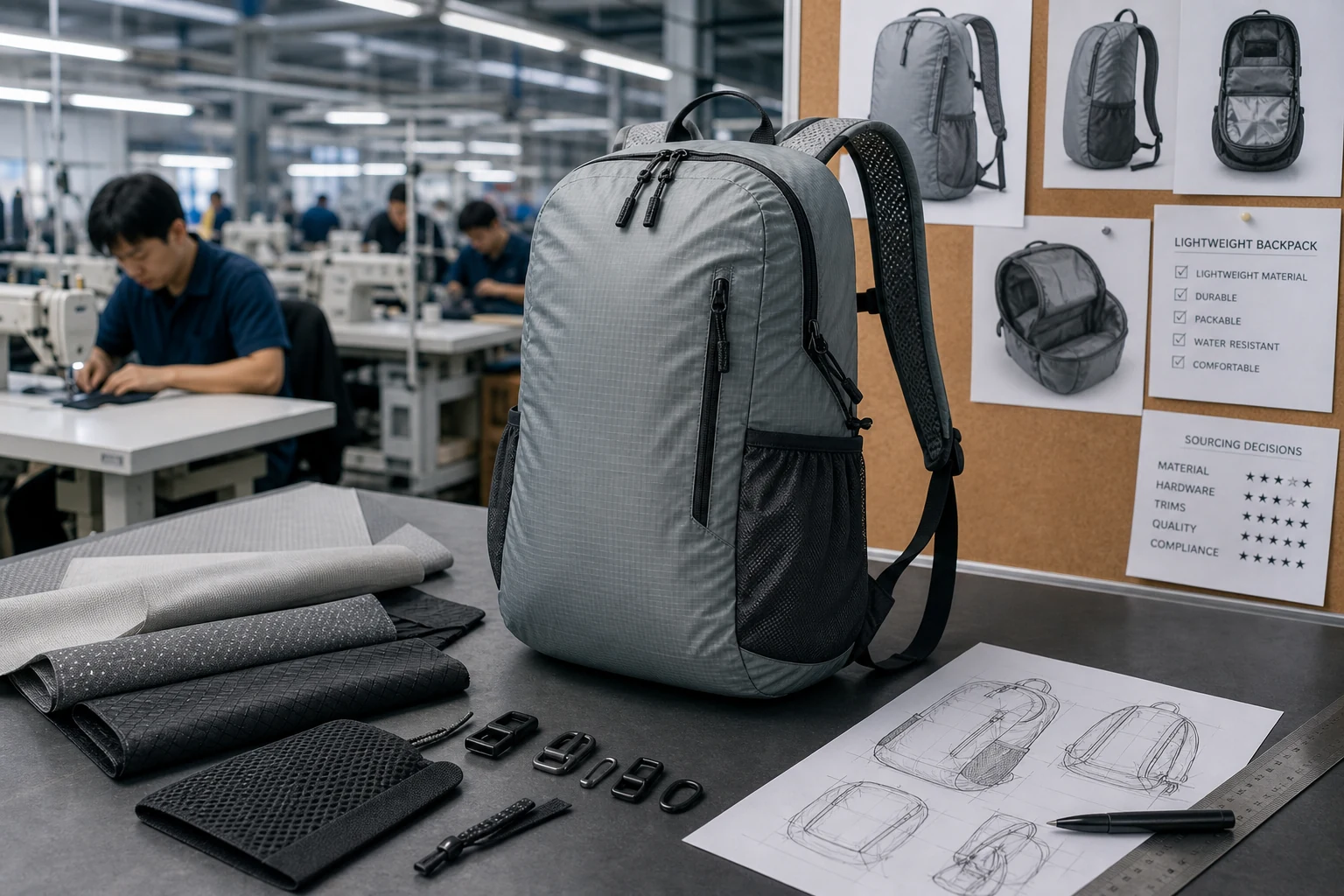
When you place an ultralight foldable backpacks for B2B bulk order, the figure on a marketplace quote is often a "skeleton price." It leaves out the reinforcements a retail-ready product actually needs.
To make sure the run holds up, specify the following in your tech pack:
- Coating Type: demand an environmentally friendly PU coating. Cheaper PVC coatings add weight and carry a chemical smell that buyers notice on arrival.
- Hardware: use YKK 3C or 5C zippers. Generic zippers snag on thin ripstop and drive up return rates.
- Lead Times: a standard run of 3,000 units typically needs a lead time of 15–30 days for light customization or 20–45 days for heavy customization at our Jinhua facility, material lab testing included. Samples move faster, usually 3-7 days once the tech pack is confirmed.
Before bulk, we run BSCI social-compliance and SGS material checks, and QC works to an AQL sampling plan so defects are caught on the line rather than at your dock. If you want to compare foldable travel construction against a heavier everyday build, our custom backpack supplier catalog lists the base models we build from.
Elandmake's Engineering Approach to Lightweight Solutions
Elandmake engineers packs instead of just stitching them. Our floor runs laser cutting tables so every panel ships with sealed edges, which stops the fraying you see on cheap ultralight gear.
Every batch passes through an X-ray needle detector and a 3,000-cycle zipper fatigue test. We don't hide behind marketing language; we hand over the 280 GSM mesh spec and the double-stitch density data because that is what a professional buyer needs to sign off an order.
If you're tired of suppliers who promise the world and deliver bags that split at the seams, talk to a factory that shows the math behind the build. Whether the job is a lightweight backpack with logo for a corporate event or a complex ultralight foldable backpacks for B2B bulk order, the rule holds: strength never gets traded away for weight.
"I'm Kevin, founder of Jinhua Yilan Industry (Elandmake). We operate a 3,000 sqm BSCI-certified factory in Jinhua with 100+ production and technical staff. If you want straight talk and real factory prices, send me your tech pack for a free audit."