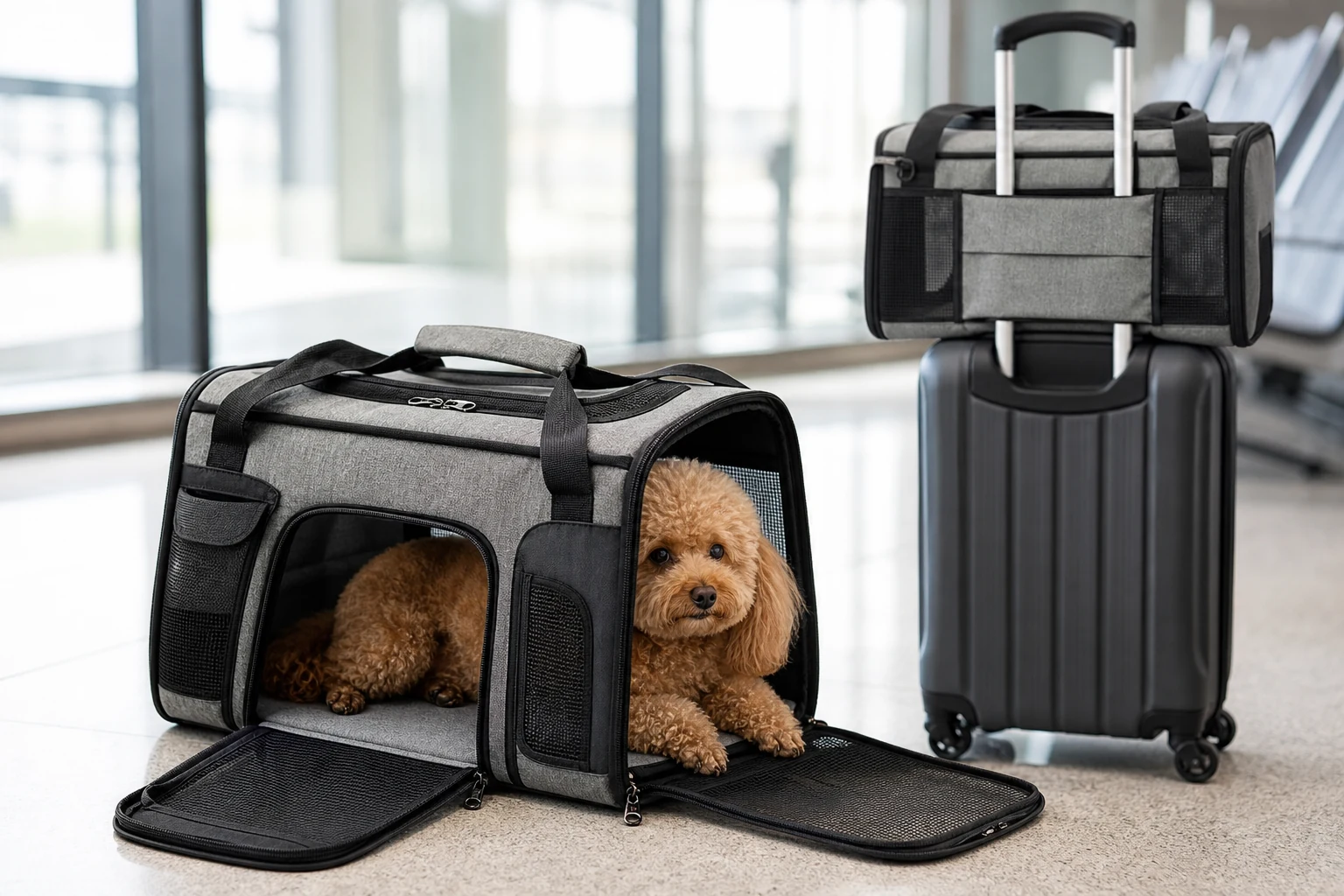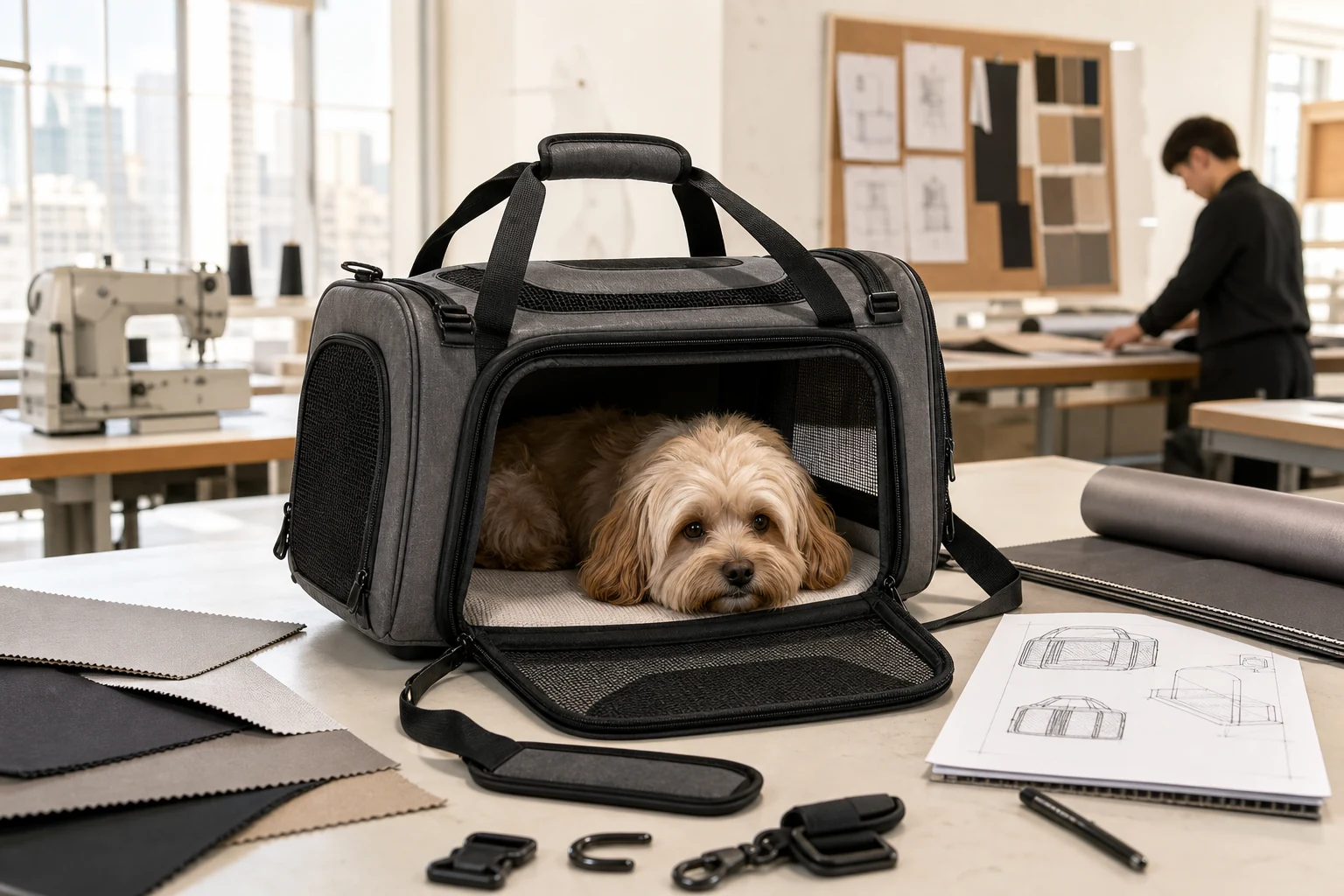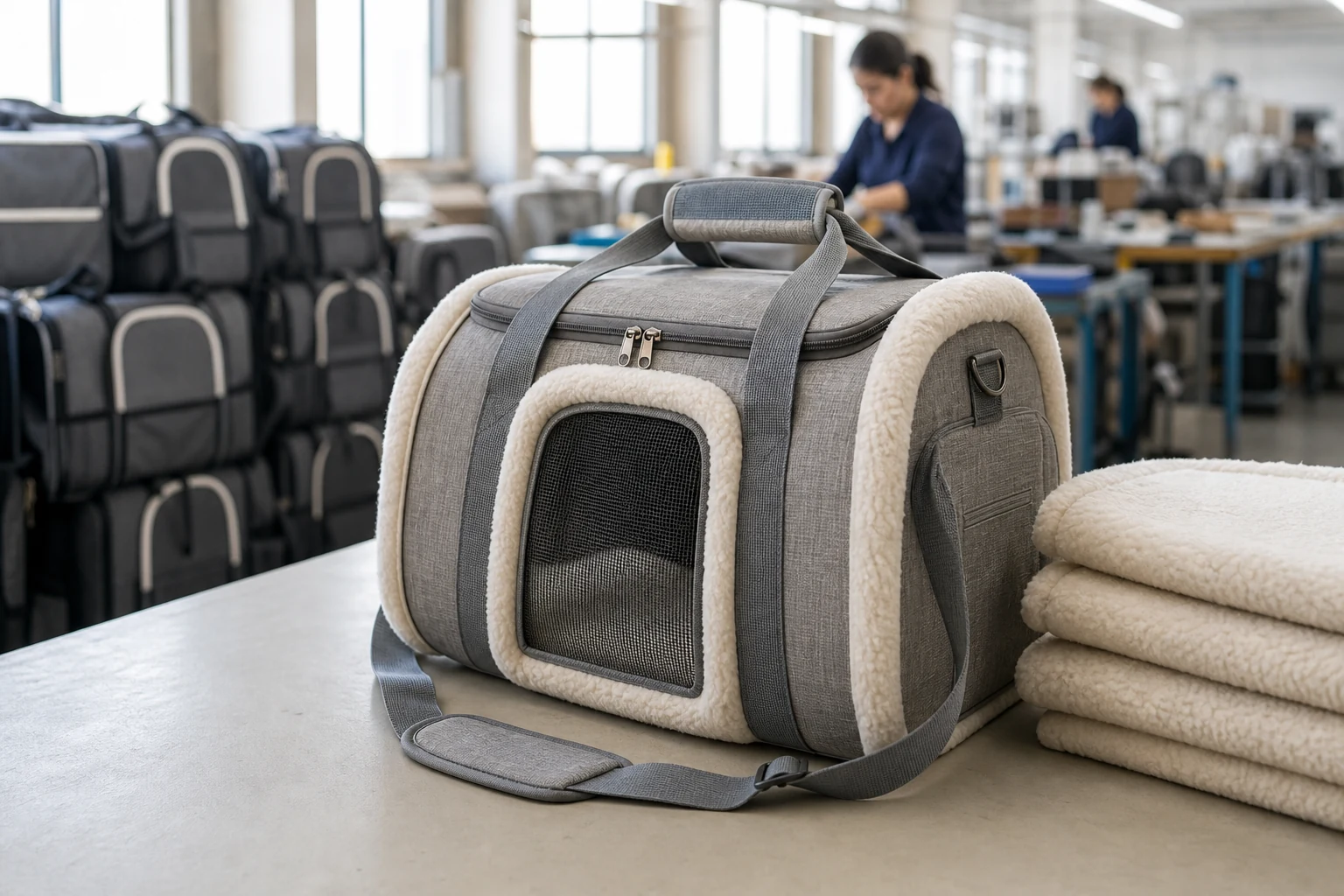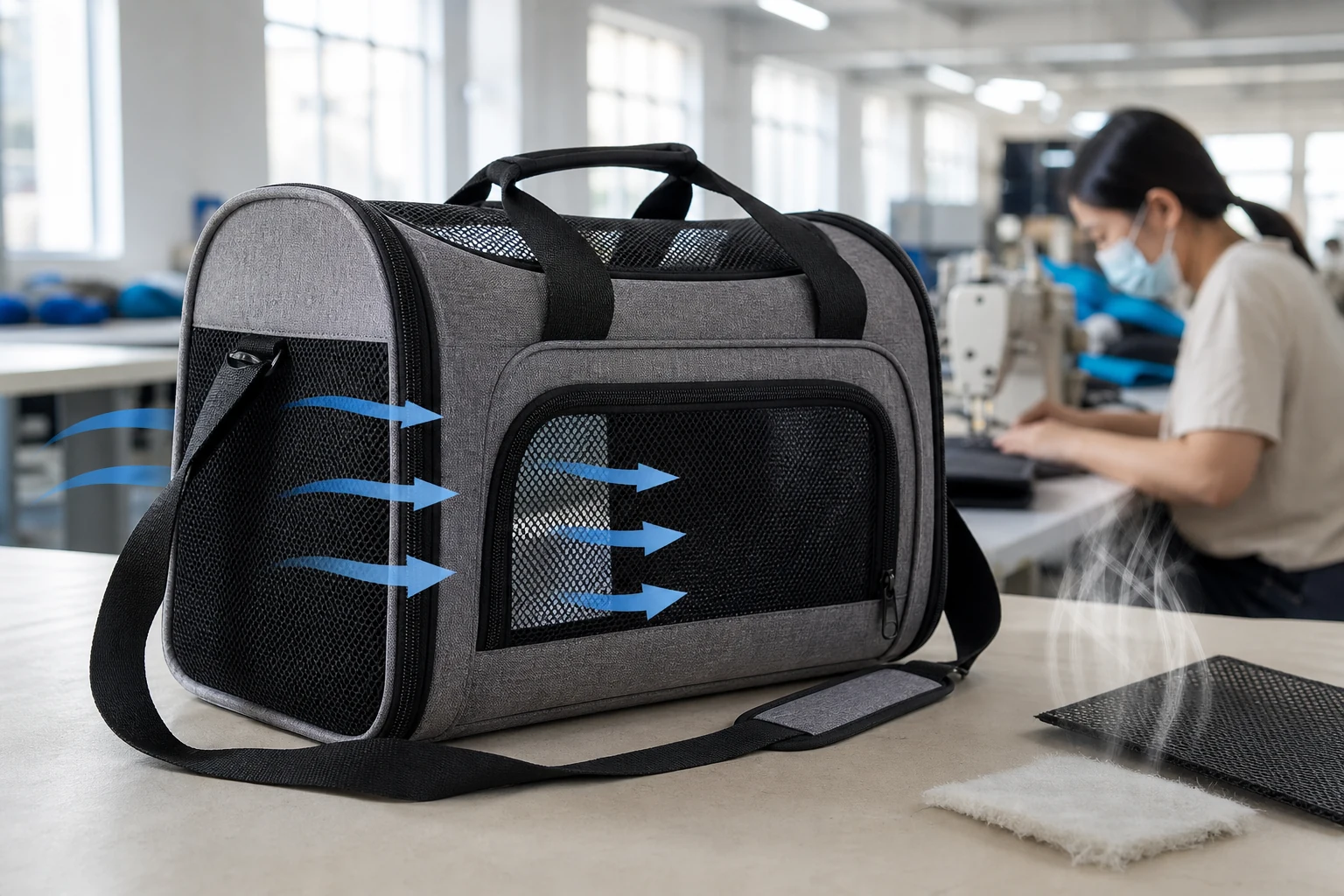
Getting pet carrier breathable mesh ventilation right is a safety requirement, not a styling choice. Airflow decides whether your product passes IATA airline rules, holds up to CPSC scrutiny, and keeps North American pet owners happy after the sale. For B2B buyers sourcing OEM pet carriers, the ventilation spec belongs in the tech pack before any production order is placed, not after the first complaint.
Pet Carrier Breathable Mesh Ventilation Explained: The Basics
Enough airflow inside a carrier prevents CO2 buildup, overheating, and stress in animals during transport. In practice, pet carrier breathable mesh ventilation is several engineering elements working together:
- Mesh panel placement: Top, sides, and/or front panels must include mesh to allow multi-directional airflow
- Mesh opening size: Holes typically 3–6mm for cats and small dogs to prevent paw entrapment
- Ventilation ratio: Combined open mesh area should equal ≥15% of the carrier's total surface area
- Structural integrity: Mesh must withstand 5kg lateral force without deforming (relevant for IATA testing)
Cheap carriers cut corners with decorative mesh that looks ventilated but never hits a functional airflow threshold. That gap becomes your brand's liability once the product ships.
Key Factors When Sourcing Pet Carrier Breathable Mesh Ventilation-Compliant Products
When you vet suppliers for pet carrier breathable mesh ventilation compliance, focus on three areas:
1. Mesh Material Grade
Three mesh materials show up in quality pet carriers:
- Polyester mesh (1680D): Most common; durable and washable, suitable for everyday use
- Nylon mesh (0.5mm openings): Finer grade; preferred for cabin-approved carriers where airline staff inspect opening sizes
- Stainless steel mesh: Used in hard-sided carriers for chew-resistant applications (large dogs, high-security transport)
Ask which grade a quoted price actually buys you. A supplier who lists denier and opening size without prompting usually knows the category.
2. Panel Configuration
Good airflow needs mesh on at least three sides. Carriers with mesh only on the front score poorly, because the air moves in one direction instead of circulating. A multi-panel layout (front, both sides, and top) sets up the passive ventilation loop that keeps air fresh even in a closed space like an aircraft cabin.
3. Mesh-to-Frame Integration
The seam between mesh panels and the carrier frame is where most units fail. Weak integration leads to mesh peeling, zipper misalignment, and structural gaps that hurt both safety and appearance. Ask your supplier for a mesh pull test certificate. At Elandmake, our mesh panels are sewn with double-lockstitch seams rated to 8kg separation force.
Industry Standards & Compliance for Pet Carrier Breathable Mesh Ventilation
Several regulatory bodies set airflow and structural requirements for pet travel products. Here is what shapes your product line:
- IATA Live Animals Regulations (LAR): Requires ventilation on at least three sides so animals get multi-directional airflow throughout transport. Full guidelines are on the IATA Live Animals program page, and we cover the manufacturing side in our guide to IATA airline pet carrier requirements.
- CPSC (US Consumer Product Safety Commission): No mesh-specific airflow standard, but general safety rules prohibit sharp protrusions and require structural stability
- ASTM F963 (Toy Safety Standard): Referenced by some retailers for children-adjacent pet products; covers mesh opening sizes to prevent entrapment
- BSCI Audit: Checks whether factory production processes for mesh integration follow documented quality procedures
Elandmake is BSCI and SGS certified, and we provide compliance documentation for buyers importing to the US, Canada, and the EU.
Material & Quality Breakdown for Pet Carrier Breathable Mesh Ventilation Compliance
A carrier that actually performs starts with the bill of materials. Use this as a quick reference:
- Outer shell: 600D or 1680D polyester or nylon for structure and weight management
- Mesh panel: 2×2 weave polyester or nylon; denier should be ≥200D for durability
- Padding: EVA foam base (8–12mm) holds the carrier's shape and protects animals from hard surfaces
- Zipper system: YKK #5 or equivalent two-way zipper for easy access without slackening mesh panel tension
Our pet dog and cat backpack range uses 1680D polyester mesh rated for 10,000+ open/close cycles, so the product survives real handling by demanding pet owners. Buyers who want a mesh-first build can start from our custom mesh pet carrier factory line and adjust panel layout, colorway, and branding from there.
Common Mistakes When Ordering Pet Carrier Breathable Mesh Ventilation Products
These errors turn up again and again in low-quality OEM orders:
- Specifying mesh by appearance only: Mesh that looks ventilated may still miss the airflow ratio. Ask the factory for a ventilation area calculation.
- Ignoring mesh color fastness: Dark mesh absorbs heat; light mesh shows dirt. Specify UV-stable dye treatments for outdoor-use carriers.
- Not testing at scale: Order a pre-production sample of 5 units, not 1. Mesh consistency varies more than fabric consistency across a batch.
- Overlooking cleanability: Owners wash carriers often. Mesh should survive 30 machine wash cycles at 30°C without shrinking or delaminating from the frame.
Each of these is cheap to catch at the sample stage and expensive to fix once a container has landed.
Finding the Right OEM Partner for Pet Carrier Breathable Mesh Ventilation
The OEM partners worth shortlisting pair design skill with documented QC. Look for:
- BSCI or equivalent social compliance certification
- In-house or third-party mesh testing capabilities
- A design team that can tune panel layout for both compliance and looks
- Sample lead time of 7 days or less
An honest supplier will also talk numbers early: MOQ, sample turnaround, and bulk lead time. Our baseline is MOQ 300 pieces per style and colorway, samples in 3–7 days, and bulk production in 15–30 days for light customization or 20–45 days for heavy customization, with AQL inspection before anything ships.
Elandmake has built ventilation-compliant dog outing bags and airline-ready carriers for buyers across North America since 2015. Every sample ships with a ventilation area measurement report, and private-label branding is available on all lines.
Ready to source your custom pet carrier? Contact Elandmake for a free factory quote — our team responds within 24 hours.