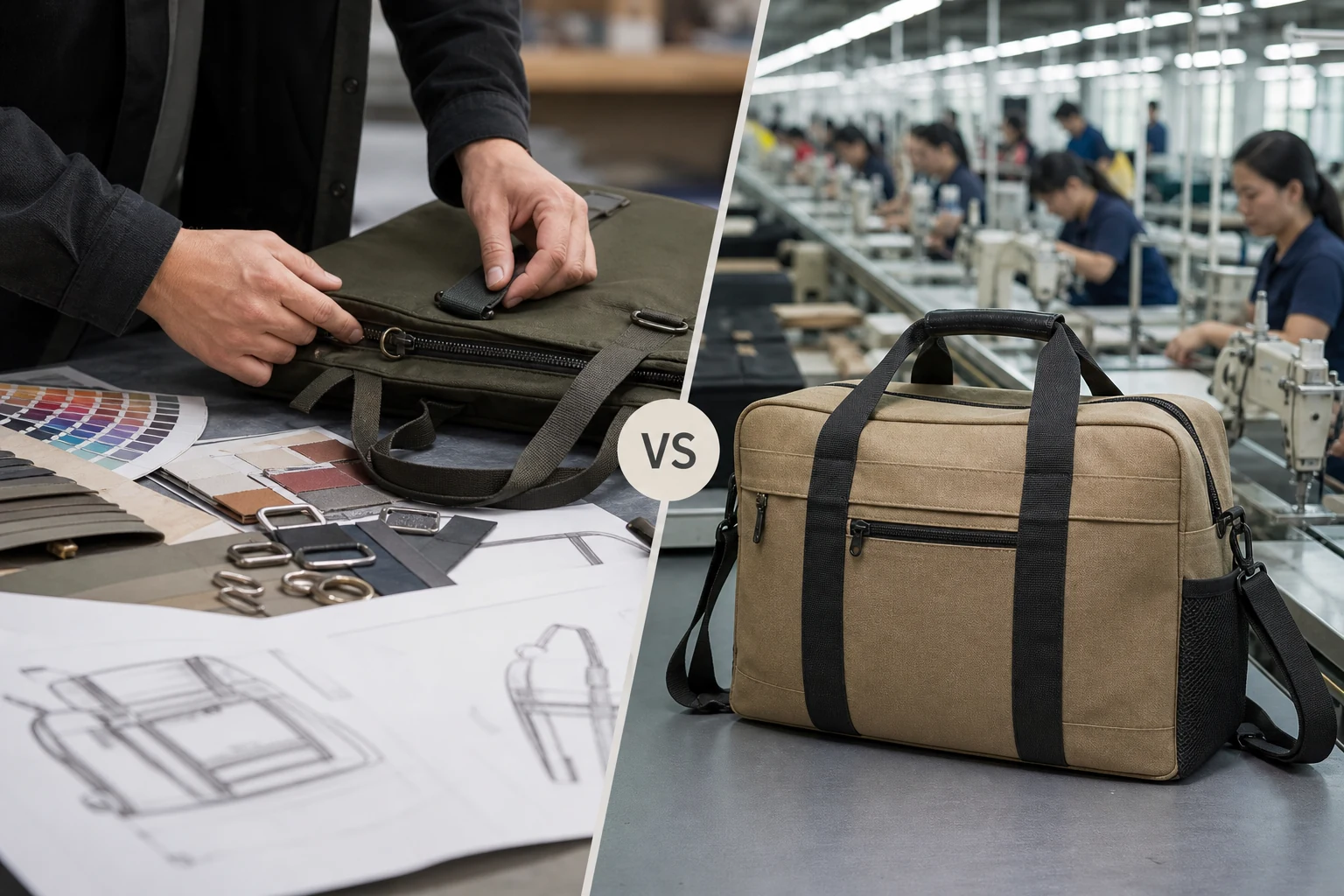
OEM means you supply the design and tech pack and the factory builds exactly that; ODM means you start from the factory's existing design and rebrand it. OEM gives you differentiation and ownership of the pattern but costs more time and development work; ODM gets you to market faster and cheaper but your product also exists in your competitor's catalogue. Most brands should use ODM to validate a category and OEM once the volume justifies owning the design.
Choosing between OEM vs ODM bag manufacturing decides how much creative control you keep, how fast you reach market, and what your gross margins look like 18 months out. Most North American brand owners pick one model without weighing the trade-offs. They end up paying ODM premiums for a "custom" product they could have OEM'd, or attempting OEM with a tech pack the factory can't build from. This guide compares the two models from the buyer's side, so you can match the model to your brand stage and capital position rather than the factory's preference.
OEM vs ODM Bag Manufacturing in North America 2026: Market Overview
The B2B bag sourcing market splits along a clean line. Brands with internal design capability and firm product specs go OEM. Brands that want speed to market and lower upfront design spend go ODM. Roughly 60% of mid-tier private label bag brands now run a hybrid: OEM for their hero SKUs, ODM for category fillers.
Here's the core distinction:
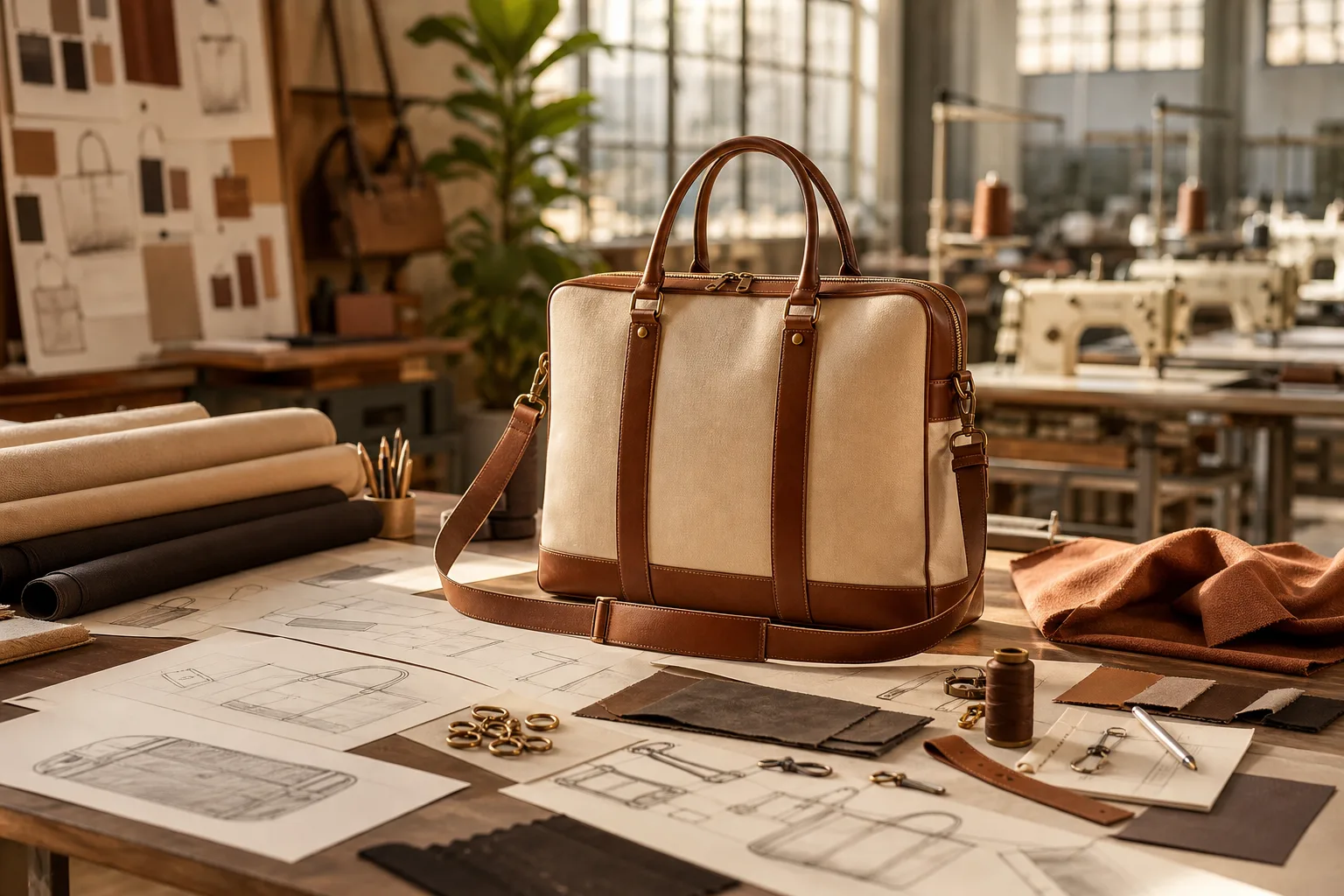
- OEM (Original Equipment Manufacturing) : You provide the design (tech pack, sketches, samples). The factory builds to your exact spec. You own the design IP.
- ODM (Original Design Manufacturing) : The factory supplies existing designs from its catalog. You customize colors, branding, and minor features. The factory owns or co-owns the design IP.
Elandmake runs both models from our Jinhua facility: BSCI and SGS certified, MOQ 300 pieces per style and colorway, 3–7 day sampling, and bulk production of 15–30 days for light customization or 20–45 days for heavy customization. Which model fits depends on where you sit as a brand. If you're weighing the OEM route specifically, our OEM backpack factory guide walks through spec handoff and tooling in more detail.
Trend 1: OEM vs ODM Bag Manufacturing Speed Differential
The path from brief to bulk shipment varies sharply between models:
| Stage | OEM Timeline | ODM Timeline |
|---|---|---|
| Design phase | 4-12 weeks (your team or paid designer) | 0 weeks (factory catalog) |
| Tech pack development | 2-4 weeks | 0-1 week (minor mods) |
| Sampling | 3-7 business days | 3-5 business days |
| Sample revisions | 1-2 rounds standard | 0-1 round typical |
| Bulk production | 15–30 days (light) / 20–45 days (heavy) | 15–30 days (light) / 20–45 days (heavy) |
| Total brief-to-shipment | 14 -22 weeks | 6 -10 weeks |
For seasonal launches like back-to-school or holiday Q4, the timing math tilts hard toward ODM. A brand that decides on April 25 to launch a Q4 holiday gift bag has room for ODM but not for a full OEM design cycle.
Trend 2: OEM vs ODM Bag Manufacturing Cost Structure
Cost comparison on a 1,000-unit order (representative ranges, not Elandmake-specific quotes):
- OEM unit cost : Typically 15-30% lower than the ODM equivalent at scale, because you're not paying a design royalty
- OEM upfront investment : $3,000-$15,000 in design fees, tech pack development, and 1-2 sampling rounds
- ODM unit cost : Higher per unit, but no design fees and faster cash conversion
- ODM upfront investment : $200-$1,000 in sampling and minor customization fees
The break-even sits around 1,500-3,000 total units. Above that band, OEM beats ODM on total cost. Below it, ODM is usually the smarter economic call. The materials you spec move this line too: standard 600D or 900D polyester and nylon builds cost less than an Oxford cloth or PU leather construction with YKK zippers, and those choices carry across both models.
Trend 3: OEM vs ODM Bag Manufacturing IP & Differentiation
This is where the decision gets serious for brands building long-term equity. With OEM:
- You own the design IP completely, so no other brand can sell the same product
- You can register design patents, trademarks, and trade dress protection
- Your factory typically signs an NDA that keeps your design off competitors' desks
- Your competitive moat compounds over time
With ODM, the same design can land in a competitor's catalog next month. Some factories offer "exclusivity windows" of 3-12 months at a premium, but exclusivity ends when the contract does. For brands competing where listing differentiation drives ranking, that gap matters. If you're building a distinct label rather than reselling a stock design, our private label bag manufacturing guide covers branding, packaging, and IP handling.
Trend 4: OEM vs ODM Bag Manufacturing Hybrid Approach
The fastest-growing pattern in sourcing is the split model: OEM for hero SKUs (60-70% of revenue) and ODM for category fillers (30-40% of revenue). It lets you:
- Put design capital where it earns the most return, on high-volume signature products
- Move fast on trend-driven SKUs without committing to multi-month design cycles
- Test new categories with low capital risk before deciding to OEM a custom build
- Keep catalog breadth without staffing a full in-house design team
About 40% of our current client base runs this hybrid model. We support both production tracks at MOQ 300, with the same BSCI compliance and 3-7 day sampling either way.
What These OEM vs ODM Bag Manufacturing Trends Mean for B2B Buyers
Three takeaways for buyers:
- Match the model to brand stage : New brands launching one product go ODM. Established brands with proven SKUs go OEM. Multi-product brands go hybrid.
- Don 't pay OEM prices for ODM goods: Some factories quote "OEM" pricing on lightly modified catalog products. Always ask whether the design already exists in the factory's portfolio.
- Verify exclusivity claims in writing : ODM exclusivity is contractual, not implied. Get the duration, geography, and channel restrictions into your PO.
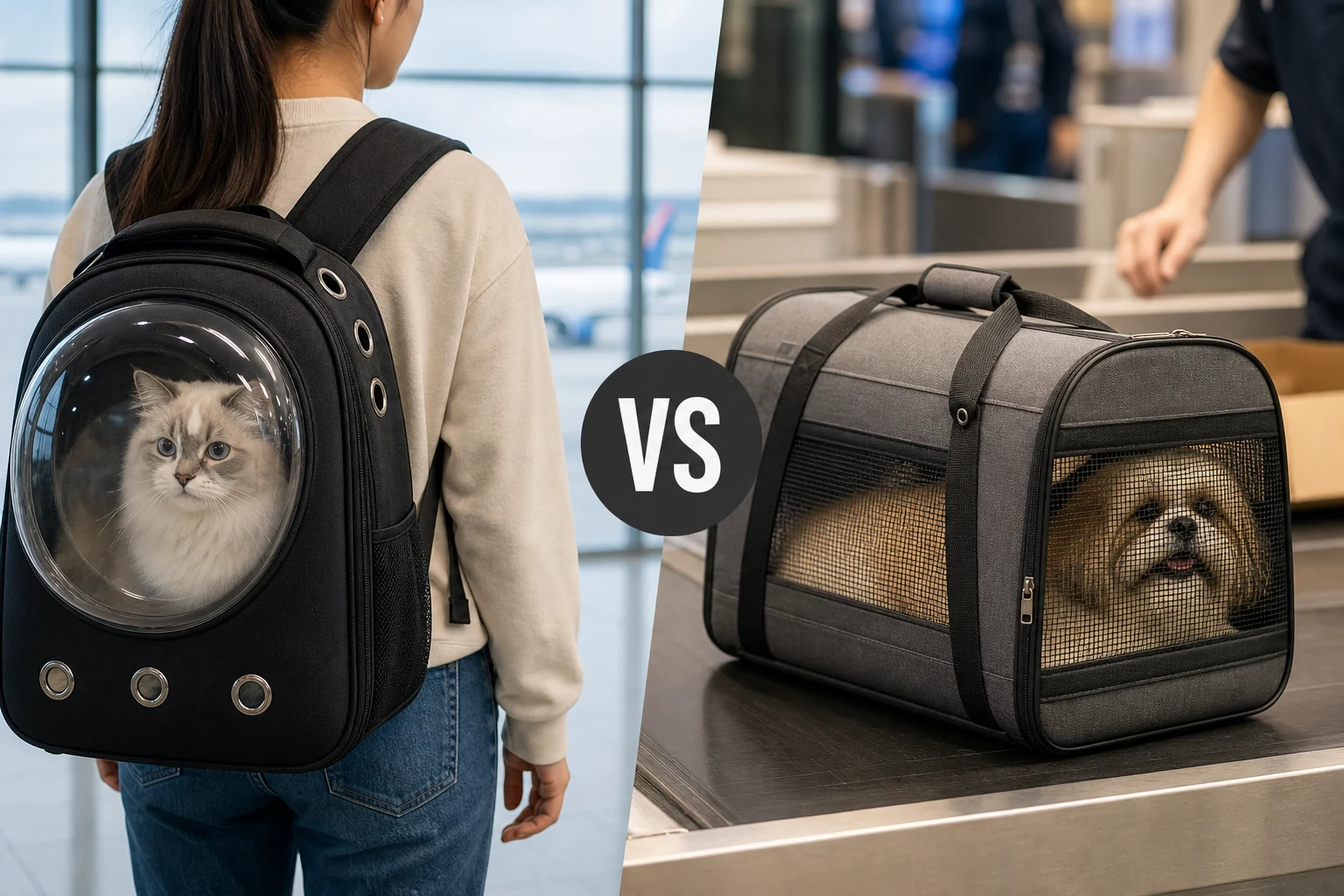
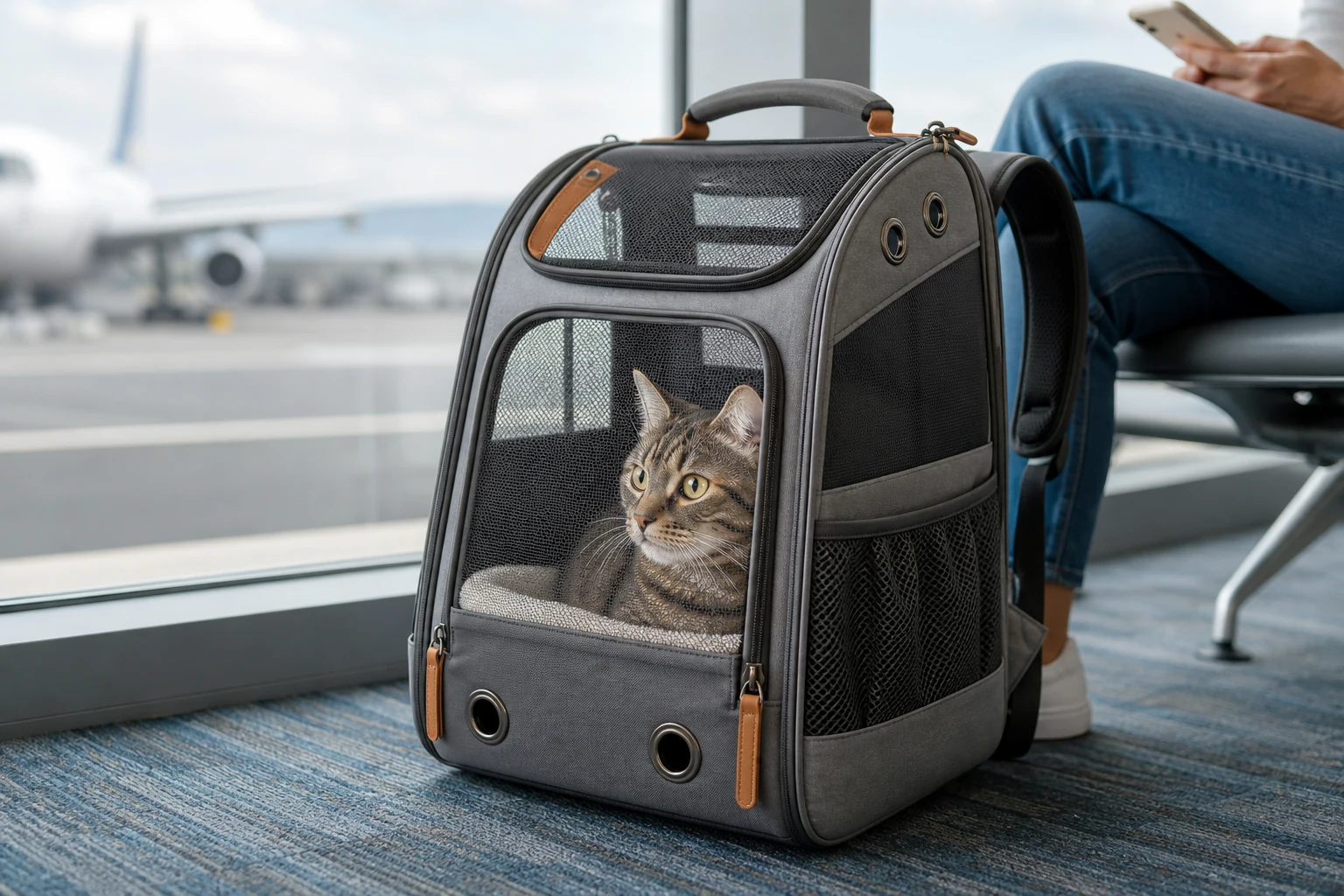
For pet brands weighing the two models, our pet backpack OEM line and dog outing bag ODM catalog show how one factory handles both production tracks.
Sourcing for OEM vs ODM Bag Manufacturing at Scale
Once you're scaling past 5,000 units a year across multiple SKUs, four operating principles separate the buyers who keep margins from those who lose them:
- Consolidate your supplier base : One factory running both your OEM and ODM tracks means consistent quality standards, simpler shipping, and pooled order volume for stronger MOQ terms
- Document everything : Tech packs, NDAs, exclusivity terms, AQL inspection standards. Verbal agreements collapse at the worst possible moment
- Keep compliance documentation central : BSCI audit reports, SGS material certificates, and any CPSIA or safety test results belong in one place for buyer due-diligence requests. Our BSCI certified factory overview explains what a full audit trail looks like
- Build factory relationships, not just transactions : Long supplier relationships of 10-plus years earn better terms, faster issue resolution, and priority capacity in busy seasons. Elandmake's longest-tenured client started in 2015
Whichever way you go, the factory economics hold steady: MOQ 300 pieces per style and colorway, 3–7 business day samples, 15–30 day bulk runs, in-house QC to agreed AQL levels, BSCI and SGS certified production, and Nylon, Polyester, Oxford Cloth, PU Leather, and Canvas across the materials library. We supply BSCI documentation on request.
Ready to source your custom bag, OEM or ODM? Contact Elandmake for a free factory quote and our team responds within 24 hours.