Sourcing custom pet bags from China works in five steps: define the use, specification and target cost; shortlist factories with traceable audit evidence; approve a physical sample; confirm the destination-market requirements; and inspect the finished order before shipment. Elandmake's standard terms are MOQ 300 pieces per style and colorway, sampling in 3-7 days, and production in 15-30 days for light customization or 20-45 days for heavy customization.
At a Glance: Choosing the Shell Fabric
| Fabric | Character | Typical positioning |
|---|---|---|
| 600D polyester | The most economical standard fabric | Entry price points |
| 600D nylon | The common standard-grade choice | Mid-market |
| 1680D nylon | Premium weight, much higher abrasion and puncture resistance | Lifestyle pet brands |
Two things to hold firm on regardless of fabric: 300 pieces is the floor for quality production, and certification claims need verifying - fake and expired BSCI and SGS certificates circulate in this market.
How to Source Custom Pet Bags from China: The Basics
Sourcing custom pet bags from China is one of the most commercially useful skills a pet brand owner can build. Most of the world's bag production sits in the Zhejiang and Jinhua manufacturing corridor, where MOQs start around 300 pieces, materials run from standard Polyester up to 1680D Nylon and PU leather, and bulk production moves from factory to delivery in about 15–30 days for light customization or 20–45 days for heavy customization.
This guide walks North American pet brand owners, Amazon private label sellers, and wholesale buyers through the full path — from picking the right factory type to landing a compliant, branded first shipment. The buyers who do this well share one habit: they show up prepared, with a clear brief and realistic expectations on timelines and minimums.
Key Factors to Define Before You Learn How to Source Custom Pet Bags from China
Before you contact a single supplier, settle the questions that decide what your product actually is and which factory can build it. A vague brief produces a vague sample and an inaccurate quote, and that costs weeks before production even starts.
The factors to lock down in advance:
- Product category: Soft-sided travel carriers, IATA airline-approved cabin bags, pet backpacks, hard-shell carriers, or convertible multi-function bags. Each needs a different factory specialization and construction skill set.
- Target market compliance: IATA for airline travel, CPSC for US consumer safety, BSCI for ethical-sourcing audits that major retailers ask for, and California Prop 65 for chemical content in materials.
- Material and budget tier: 600D Nylon (standard), 1680D Nylon (premium), Oxford Cloth, Polyester, PU leather, or Canvas. Each sets a different price point and retail position. Our comparison of pet travel bag materials breaks down where each one fits.
- Branding requirements: Logo method (embroidery, woven label, heat transfer), colorway count, retail packaging specs, and any labeling required for US import.
- Order volume and timeline: Most OEM factories need a minimum of 300 pieces per style to run economically with full QC. Your launch date sets when sampling has to begin.
Documenting these answers before your first inquiry cuts weeks off the process and sharpens every quote you get back. This one preparation step often separates buyers who source successfully on the first try from those who cycle through three factories before finding one that fits.
Industry Standards & Compliance: What Every Buyer Must Know
Compliance is not optional for any brand serious about the North American pet market. Skip the certification checks before production and you risk chargebacks from retail buyers, marketplace listing suspensions, and costly returns — all avoidable with proper factory vetting upfront.
The compliance frameworks worth understanding:
- BSCI (Business Social Compliance Initiative): Verifies fair labor practices, wages, and safe working conditions through annual independent audits. Required by most major US retailers and marketplaces.
- SGS Certification: Third-party material safety testing for chemical content, colorfastness, and physical durability. Especially important for bags in contact with pets and children.
- IATA Compliance: Airline-approved carriers must conform to IATA Live Animals Regulations on cabin dimensions, ventilation coverage, and latch security. Airlines enforce these at the gate, and a non-compliant carrier means a pet left behind.
- CPSC Standards: The US Consumer Product Safety Commission publishes guidance for pet products with hardware, dyes, or materials that may reach children in the household.
Elandmake holds current BSCI and SGS certifications, with full audit documentation available on request. Starting with a factory whose credentials you can verify removes the biggest compliance risk from a first-time sourcing project.
Material & Quality Breakdown: What to Specify in Your Brief
Material choice is where quality, durability, and price meet, and it decides how your product reads in the North American market. A practical breakdown for a custom pet bag project:
- 600D Nylon: The common standard-grade choice. Good abrasion resistance, wide color range, takes embroidery well. Mid-market positioning.
- 1680D Nylon: Premium weight with much higher abrasion and puncture resistance. Suited to airline-approved carriers and outdoor brands. Costs more, but the longer lifespan carries the price.
- Oxford Cloth: Distinctive texture, good water resistance with a TPU coating, cost-effective for soft-structure carriers. Popular with lifestyle pet brands.
- Polyester (600D): The most economical standard fabric. Strong for entry-level or high-volume SKUs where margin control comes first.
- PU Leather: A premium look for boutique brands. Wipes clean, holds up well at the surface — pair it with full mesh panels for enough airflow.
- Canvas: Heavy, durable, and easy to position as eco-friendly. Used by sustainable and natural-lifestyle pet brands.
- Mesh panels: Quality swings widely between factories. Always request certified breathability specs, since mesh grade drives both airline compliance and product reviews.
Our pet backpack and carrier range runs these materials across several product lines, so buyers can see live production references. Reviewing what a factory already builds at scale is one of the better ways to judge it before you commit to a custom build.
Common Mistakes That Cost Brands Time and Money
The brands that struggle most here are usually not the ones with the smallest budgets. They are the ones who skip the steps that protect them. The most expensive and most predictable mistakes first-time buyers make:
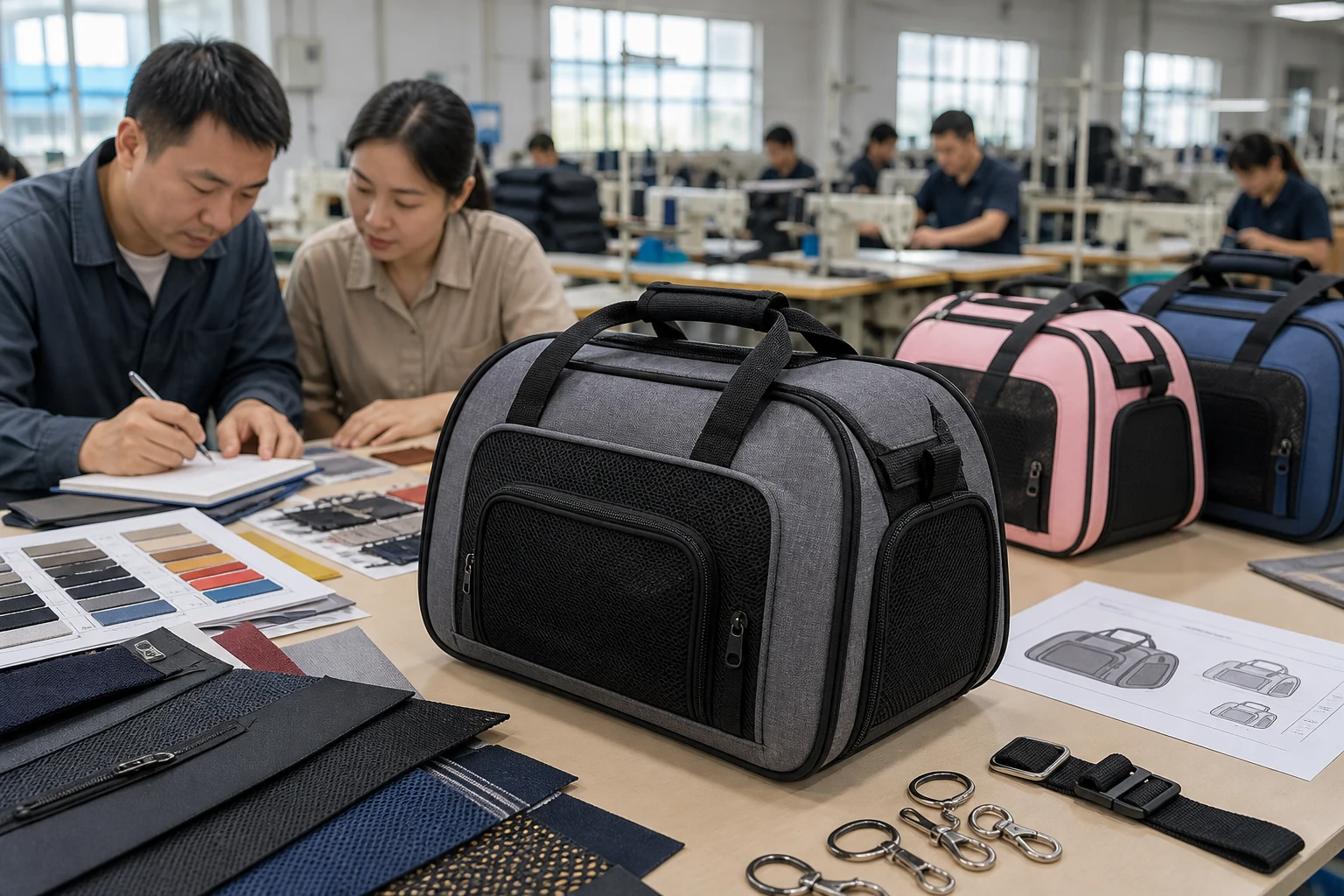
- Approving from photos only: A photo tells you nothing about stitch density, zipper pull weight, latch feel, or material hand. Require a physical sample and test it yourself before authorizing production.
- Not signing an NDA before sharing designs: A reputable OEM factory will sign a non-disclosure agreement without hesitation. One that refuses is a signal to end the conversation.
- Ordering below MOQ to "test the market": Sub-MOQ runs mean higher per-unit costs, thinner QC coverage, and sometimes off-spec material substitution. The 300-piece minimum is the floor for quality production.
- Taking certification claims at face value: Fake or expired BSCI and SGS certificates circulate in the market. Ask for the certificate number and verify it with the issuing body when you start with a new supplier.
- Underestimating total lead time: New buyers budget for production but forget sample production and approval (3–7 days) plus sea freight to the US (25–35 days). First orders typically run 70–100 days from inquiry to delivered goods.
- Vague tech packs: A brief that says "similar to this product" with no measurements, material specs, or construction notes produces samples that miss the reference. Build a proper tech pack before sampling begins. Amazon sellers can see how this maps to a launch in our private-label pet bag guide for Amazon sellers.
Finding the Right OEM Factory Partner
Sourcing custom pet bags well comes down to one decision: which factory do you trust with your brand's product quality? The criteria that separate reliable OEM partners from risky ones are straightforward:
- 10+ years of specialized bag and pet accessory manufacturing, not a generalist that added pet bags recently
- Current, verifiable BSCI and SGS certifications — verified, not just claimed
- Sample production within 3–7 business days of a confirmed brief
- Transparent, itemized quoting; a factory unwilling to itemize is hiding a cost structure
- English-speaking account management for North American buyers
- NDA signing as standard practice before any design file is shared
- Visible references or case studies from North American or European brands
Elandmake has helped North American wholesale buyers, boutique brands, and Amazon private label sellers build their pet bag programs since 2015. Our OEM pipeline — from tech pack through sample, production, QC, and FOB shipping — is built to stay predictable and transparent for buyers working remotely.
Visit our dog and cat outing bag product range to review current production capabilities, or reach out directly to talk through your brief and timeline.
Ready to start sourcing custom pet bags from China? Contact Elandmake for a free factory quote — our team responds within 24 hours.